Your chart's precision
How your chart
is calculated
and why, here, it comes out astronomically correct
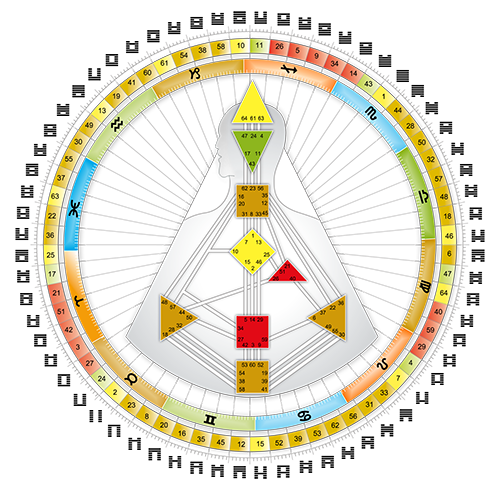
Every Human Design chart starts with an astronomy question: where were the planets at the exact moment you were born?
It sounds simple — but there is one detail in that question that changes everything, and that most Human Design systems handle by approximation. Here, we don't. Here your chart is calculated with the real sky time — and on this page we explain exactly what that means.
If you have already generated your chart somewhere else and noticed a difference here — a line, a gate, and in rare cases even your Type or Authority — this page explains why. And if you have never compared anything, great: you will understand how your chart was built with a care that few take.
To know where the planets were when you were born, you need to know what time it actually was — the real astronomical time, not just the clock time.
And here is the detail that almost no one considers: in many places and eras, clocks were set forward for daylight saving time. When that happened, the time shown on the clock (and on the birth certificate) was one hour ahead of the real astronomical time.
Most Human Design software ignores this. Ours does not. At the moment it generates your chart, our system checks whether daylight saving time was in effect at your birth location and date — and adjusts with precision.
Result: your chart here reflects the real position of the planets in the sky when you were born. You can trust it.
If that was all you wanted to know, you can move on with confidence. If you are the type who likes to understand things deeply — keep reading. All the math is below.
How do I know if my birth was affected?
Only those born during a daylight saving time period — in any country that adopted it, at any point in history. Over the centuries, dozens of countries have adopted (and many later abandoned) daylight saving time, each with its own dates. No matter where you were born: our system checks this automatically, consulting the historical timezone record for your location and birth date.
If daylight saving time was in effect when you were born, the adjustment has already been applied to your chart — and it comes with a badge indicating this. You don't need to calculate anything.
The story of two chartsRobert and Yvan — father and son
The clearest way to understand this is with a real case — and this one is from our own family.
Robert and his son Yvan were born in the same city. Robert was born in July; Yvan, in November.
Yvan
born in November
Our system vs. traditionalIdentical result.
Planet by planet, no difference at all.
Robert
born in July
Our system vs. traditionalThe results diverge.
The Moon shifts to a different gate — and you will understand why that changes everything, just below.
Why the difference? Because in July, in that city, daylight saving time was in effect. In November, it was not. Our system detected this and adjusted Robert's time by 60 minutes — to the real astronomical time. Traditional systems used the clock time, without adjustment.
That single hour was enough to move Robert's Moon from one gate to another. And, as you will see next, the Moon is the most sensitive piece of the entire chart.
Why the Moon is so sensitive
This is not mysticism — it is speed.
The Sun takes about six days to cross a single gate in the chart. The Moon crosses that same gate in about ten hours.
This means that for most planets, an extra hour one way or the other almost never changes anything. But for the Moon — and for the points that depend on it — one hour can be the difference between one gate and another. And when that gate completes (or fails to complete) a channel, it can change a center, a Type, an Authority.
That is why getting the exact time right matters so much. It is not perfectionism. It is the difference between your real chart and an approximation.
How we know we are right
Three pillars support every chart we generate here:
The same ruler as Ra Uru Hu
The table that converts planetary positions into gates and lines — the foundation of all Human Design — is exactly the one in the official calculation material. We checked all 64 gates and 6 lines, one by one: they match 100% with the canonical source. Our Human Design mechanics are identical to those of the original system.
The same astronomical engine as serious science
Planetary positions are calculated by the Swiss Ephemeris — the same ephemeris base used by professional astronomers worldwide. It is not a homemade approximation; it is the standard of astronomical precision.
The timezone check at the moment of generation
Every time a chart is created, the system consults the historical timezone record for your birth location and applies daylight saving time if, and only if, it was in effect on that exact date. We tested this across dozens of scenarios — different countries, different decades, the exact changeover days — and the system was correct in every scenario with reliable historical records.
The ruler is Ra's, the astronomy is science's,
and the time is the real one.
"But what about the system I used before?"
It is probably also a good system. The difference is not in Human Design itself — it is in a single technical choice about the time.
Most software adopts, by convention, the standard time for the region, without checking the historical daylight saving time. It is a simplification that works for most births — but fails precisely in cases where the person was born during a daylight saving time period.
We chose not to simplify. We chose the real sky time. It is more work, it requires a historical timezone database covering the entire world — and that is why so few do it.
You don't have to choose between trusting us or trusting tradition. Both are born from the same ruler. We just went one step deeper into precision.
Want to learn to calculate it yourself?
Calculating a Human Design chart is an art — and one of the most fascinating to master. We are preparing a course where you will learn, step by step, to calculate a chart by hand, from scratch: from the ephemeris to the gates, from the lines to the final composition — including the astronomical precision that most courses don't teach.