At age 7 they said she was different in every place.
You remember making the comment — maybe not as a criticism, but as an observation. She went quiet. Today, as an adult, she spends hours hiding that she still changes in every place she walks into.
There's a reason adult Reflectors hold themselves to consistency. They weren't born this way. They were taught, still as children, that changing depending on the environment was a sign that something was wrong — when, in their design, it's the primary mechanic.
Your specific chart
, this post begins for whoever raised you. But it was written for you.
You were seven years old.
It was Sunday at grandma's house. At some point she observed: "You're so different here. At home you're not like this. At school your mom told me you're another child."
It wasn't criticism. It was observation. But you felt the weight. Something in it sounded like this isn't right. As if you needed to explain why you're different in every place.
You didn't have the vocabulary to say "this is how my system works."
You just felt you should apologize.
And it kept piling up. At school: "this girl is one way with the Portuguese teacher, another with the math teacher." In adolescence: "you're different when you're with that group of friends." At your first job: "you don't seem like the same person when the boss is around." In your relationship: "you change when you're with his family."
Always with a hint of reproach. Always demanding you justify yourself.
And you gradually learned to hide it. Trying to be the same everywhere. Building a "public personality" that stayed reasonably stable — so that no one else would have to ask.
The cost: you started carrying two weights at once. The natural weight of absorbing each environment — which is what your system does, without you being able to help it. And the added weight of pretending you don't absorb. Hiding the change. Presenting consistency where, mechanically, it doesn't exist.
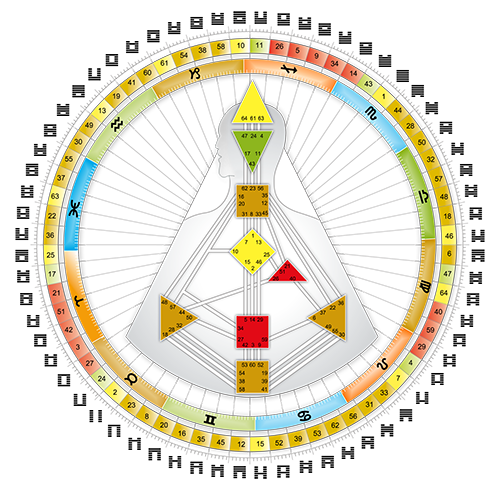
What no one told you: the Reflector is the only type with all energy centers open. You don't have a "fixed self" that stays the same across environments — because your system was made to reflect each environment it enters. Changing with each place is not instability. It's exactly how your body reads the world. It's your function.
But you were raised in a world where a stable personality is treated as a sign of health. Where the adult who changes too much is seen as insincere, dramatic, or without identity. And no one — not your grandmother, not your mother, not your teachers — had the vocabulary to say "this child is a Reflector. Changing is what she does."
So they did what seemed right: they tried to help you be someone. Stable. Recognizable. Consistent. It wasn't malice. It was the entire educational model operating on a child who was the exception, and no one knew.
The mechanical effect: as an adult, you carry guilt for changing. You apologize for feeling different in every place. You try to be the same person at the company meeting and at Sunday lunch — and you feel fake in both, because, mechanically, being the same in both is impossible for your system.
Recovering doesn't require therapy. It requires you to stop spending energy on forced consistency. To accept that you'll be one person at your mother's house and another at work — and that this isn't a lack of identity. It's an excess of reading. Your system is doing what it always has. You were just taught to be ashamed of it.
The person who raised you and heard you "change too much" wasn't wrong to observe it. The observation was correct. The error was assuming that changing was a problem. Today, with different vocabulary, she can look at the same child and see: "she's reading the environment. This is how she works."
And you, as an adult, can finally stop apologizing for being many.
You're not lost. You were made to be fluid — and you spent years of your energy trying to be fixed because no one told you that fluid was the design.
Now, the question that demands an answer
You just read about At age 7 they said she was different in every place..
Is this really about you?
Without your Chart, you are reading about someone. It might be you. It might not. And there is no way to know.
We take Human Design so seriously that even the experience we prepared for you here is unique. Because two people of the same Type can read exactly this post and need completely different guidance — depending on the activations, the gates and the channels that make up each chart.
Your Chart reveals which of these people you are.
By creating your Chart for free, the site starts to recognize:
- Your Type
- Your Strategy
- Your Authority
- Your Profile
The content stops being generic and starts speaking specifically to you.
CREATE YOUR FREE CHART NOW- ✓ Free
- ✓ No credit card
- ✓ Your Chart saved to your account