You were described before you could respond.
You were the quiet one. Your sister was the wild one. Your brother was the studious one. None of you chose — you were just catalogued, at eight years old, in the living room, while the adults talked.
There's something no one ever asked you: who you were before the first descriptions came in. You built a personality on top of what was left over — and most of what you call yourself today is the residue.
Your specific chart
, you were described before you could respond.
You were eight years old.
You were in the living room while your mother talked with your aunt. At some point they started talking about you as if you weren't there.
"This one's the quiet one. The other's the wild one."
"She's more withdrawn, you know? You have to pull to get her talking."
"The brother is the studious one. This one is the sensitive one — everything affects her."
You heard it. At eight years old, you heard it. And something specific happened: you started adjusting to the description.
If they said "quiet," you got a little quieter — to confirm it. If they said "sensitive," you started interpreting your reactions as sensitivity — to fit in. It wasn't a conscious choice. It was the oldest form of belonging: becoming the person others have already decided you are.
You didn't have the vocabulary to say "wait, I'm not just quiet, I'm also something else when I'm alone" or "the sensitivity you call weakness is my system reading the environment." At eight, no one has that vocabulary. The descriptions arrived before you had a tool to refute them — and the oldest form of belonging is becoming the person you've already been described as.
At thirty, you are exactly that. The quiet one. The sensitive one. The intense one. The withdrawn one. The down-to-earth one. The dreamer. You operate on those categories without ever having asked whether they have anything to do with what you are — or whether they're just the residue of the first descriptions that came in.
And here's what this text can give you that no one gave you at eight: the question that was never asked.
Who were you before they described you?
It's not a rhetorical question. It's a diagnostic question. It has an answer — and the answer has a chart.
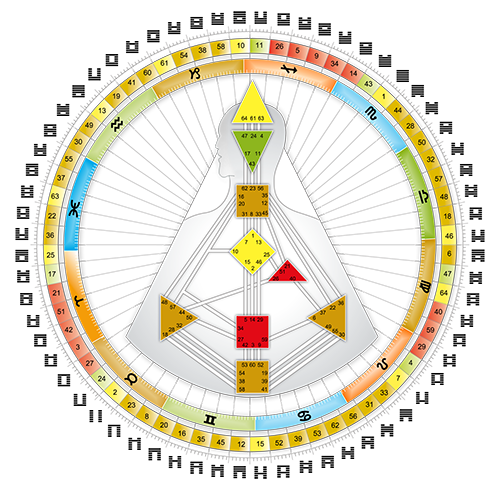
Every person has a specific energetic system — a mechanics of how the body responds, how energy distributes, how decisions are made, how the environment is processed. That system arrives before personality. Personality is what forms when the system is corrected without being recognized.
When a child has the sound of the body (the Sacral's uh-huh) corrected out, they become "rational." When their natural fluidity is charged as instability, they become "insecure." When their rhythm of observation is interpreted as laziness, they become "slow." When their sequence of initiative is broken by a demand for permission, they become "impulsive" or "dependent." When two motors are corrected for opposite reasons, they become "inconstant" or "chaotic."
Each type has a specific place where the correction entered. If you already know yours — there's a post about it. If you don't yet know, the chart exists, and it shows exactly what was installed in you.
What unites all the types isn't the same correction. It's the same mechanism of installation: the descriptions arrived before you could consent.
It's not trauma in the clinical sense. It's not abuse. It's the normal functioning of families and schools operating without a chart. Adults describe what they see — and at eight years old, you're catalogued by people who were trying to understand a child using references of the average child. The average child doesn't exist. Each one has mechanics. And when the mechanics aren't recognized, the description installs itself where recognition should have been.
The good news: the original self wasn't destroyed. It was covered. It keeps operating underneath — you feel it in the moments when something clicks without your being able to explain why, or when something that should be comfortable inexplicably drains you. Those are the original system responding.
The work isn't to destroy the personality — it's to separate what is design from what is residue. What was left over after the corrections has use. Some of the categories they applied to you, you effectively developed. Others were never yours — you just learned to inhabit them so you wouldn't stick out.
The chart has a name: Where You Lose Yourself.
It's the report that shows which center of your system carried each correction — and where, today, the personality you call yours still operates as residue. It doesn't destroy what you built. It shows what was built on top of what.
The person who described you at eight didn't do it out of malice. They were categorizing with what they knew how to categorize. But today, with a different chart, you can look at the same child catalogued in the living room and ask — for the first time — what was she, before the sentence came in?
You don't need to reject who you've become. You need to know what was chosen — and what was only inhabited because no one taught you there was another option.
Now, the question that demands an answer
You just read about You were described before you could respond..
Is this really about you?
Without your Chart, you are reading about someone. It might be you. It might not. And there is no way to know.
We take Human Design so seriously that even the experience we prepared for you here is unique. Because two people of the same Type can read exactly this post and need completely different guidance — depending on the activations, the gates and the channels that make up each chart.
Your Chart reveals which of these people you are.
By creating your Chart for free, the site starts to recognize:
- Your Type
- Your Strategy
- Your Authority
- Your Profile
The content stops being generic and starts speaking specifically to you.
CREATE YOUR FREE CHART NOW- ✓ Free
- ✓ No credit card
- ✓ Your Chart saved to your account